Blog Post


Share Publication


Estimating Microsoft's Energy Footprint in the Netherlands
In recent weeks, the development of a data center project in the city of Amsterdam has made local headlines. The debate got even more intense since a newspaper revealed that Microsoft was the sole tenant of this 78 MW project, consisting of three 80+-meters high data center towers.[^1] Attention for this new development in Amsterdam, arguably 'hyperscale' in size, was triggered by a letter[^2] sent by Leitmotiv and PILP together with a broader coalition of NGOs. It led to a debate in municipal, provincial and national politics about the desirability of Big Tech corporations developing or leasing space in hyperscale data centers in the Netherlands and the efficacy of an existing national ban on hyperscale development.
One question that we were repeatedly asked in the last few weeks is how 'big' Big Tech is in the Netherlands? How many data centers do companies like AWS, Google and Microsoft have in the Netherlands, how much land and grid capacity do they claim and what is their annual energy use? This relates to work we have started at Leitmotiv last year on our Data Center Environmental Transparency Project. We analyzed data shared with Dutch authorities by data center operators under the Energy Efficiency Directive (EED) in 2023 and further elaborated in a delegated regulation One of the key takeaways from that research was that compliance with EED reporting requirements is especially low among data center facilities that are ultimately owned by corporations headquartered in non-European countries. Indeed, if we go to the website by the Dutch authority (RVO) collecting EED data, it turns out that AWS and Google have not reported under those company names at all.[^3]
Since there has been much attention to Microsoft's role in a new hyperscale development in Amsterdam recently and there appears to be no direct reporting to the RVO by its two biggest competitors on the cloud market, this blog will zoom in on the question: how big is the energy footprint of Microsoft in the Netherlands approximately? The honest answer to that question is that no one outside Microsoft and Dutch grid operators knows exactly. All we can do is try to estimate it—transparently and with open methodology—so that others, including Microsoft, can verify, critique, or improve upon our calculations and estimates. At Leitmotiv, we strongly believe that transparency about the production of digital resources is essential for evidence-based policy-making and informed public debate and we welcome a debate about the energy-intensity of this production.
Our key takeaways: Using publicly available data and (what we think are) reasonable assumptions, we estimate Microsoft's data centers in the Netherlands currently claim approximately 548 MW of grid capacity—equivalent to the grid capacity claimed by over 1,9 million Dutch households. We estimate Microsoft's annual electricity consumption at around 1,68 TWh, which equals 33% of the electricity use of all data centers in the Netherlands using figures from the national statistics office for 2024.[^4] This estimated electricity use by Microsoft equals almost 1,4% of all electricity use in the Netherlands in 2024.[^5]
What We Know from Official Sources
Microsoft reported only two data center facilities to the Dutch authorities, RVO, for 2024:[^6]
Facility | Location | Total Floor Space | IT Floor Space | IT Power Demand |
|---|---|---|---|---|
AMSESG1_103 | Haarlemmermeer | 95,833 m² | 68,111 m² | Confidential |
AMSESG2_104 | Haarlemmermeer | 47,565 m² | 26,382 m² | Confidential |
Total Reported | 143,398 m² | 94,493 m² | Unknown |
What We Don't Know
Before presenting our estimates, we want to be clear about the significant gaps in publicly available information:
1. The full extent of Microsoft's data centers in the Netherlands
Microsoft reported only two data center facilities to Dutch authorities under the EED, both located in Haarlemmermeer. It is well-known that Microsoft also owns or operates hyperscale facilities in Middenmeer (Hollands Kroon),[^7] but these facilities do not appear in the EED data held by RVO.
2. Microsoft's actual grid capacity claims
We do not know precisely how much capacity Microsoft's facilities have reserved on the Dutch electricity grid. The EED reports submitted to RVO by Microsoft for facilities in Haarlemmeer lists "total IT power demand" as confidential.
3. Microsoft's actual electricity consumption
As far as we know, Microsoft has not disclosed how much electricity its Dutch data centers consume annually.
4. Utilization rates
We do not know how much of the available IT floor space is actually utilized, meaning how much IT equipment has been placed there and is running. Neither do we know the utilization of the IT equipment itself, meaning if the IT equipment is doing "work" or if it is idling.
For our calculations we consider only the probable utilization of the grid connection itself. Due to the fact that data centers have redundant power supply, meaning they contract about twice as much power as they will ever use, the upper limit for our assumptions is 50% utilization, though public sources indicate the utilization may be as low as 35%.[^8]
Based on earlier research of RVO data by Leitmotiv, we estimated, based on the data from data centers that reported both contracted power capacity and energy use, that data centers may be between 33% to 50% utilized. To stay on the conservative side, we use the assumption that 35% of the contracted grid capacity is utilized and from this we derive the estimated electricity consumption.
5. Pipeline projects
Microsoft has publicly announced expansion plans in Middenmeer (Hollands Kroon) for an additional 50 hectares of hyperscale development. After public attention, Microsoft also told journalists at NRC it will be the sole tenant of the above-mentiond 78 MW facility in Amsterdam Sloterdijk.[^9] But few details are known about these two projects and we do not know if Microsoft has other planned projects in the Netherlands.
Our Estimates
Based on publicly available data, we have attempted to estimate Microsoft's total reserved grid capacity and energy use from their operational data centers in the Netherlands. We emphasize that these are our estimates, not verified facts and invite anyone to verify, critique or expand upon our calculations.
Our calculation follows these steps:
Step 1: Estimate total floor area
Haarlemmermeer (from EED reports to RVO): 143,398 m²
Middenmeer (from satellite/GeoData analysis): a total plot size of 542,000 m2[^10] of which 43% is occuppied by the data center buildings based on Microsoft's own engineering diagrams[^12]
Total estimated floor area: ~391,634 m²
Step 2: Estimate total IT floor space
IT space/computer room floor area we estimate to be around 85% of total estimated floor area. Further, we include additional 75% spatial overhead in each rack, assuming 4 m² per rack.
Total estimated IT floor space: 85% x 391,634 m² =~332,889 m²
Step 3: Estimate grid capacity from IT floor space
We use a conservative rack density assumption and PUE:
1 rack per 4 m² of IT floor space
3 kW per rack for Haarlemmeer facilities
6 kW per rack for Middenmeer (Hollands Kroon) facilities
Average annual operational PUE of 1,38 for all facilities
Total estimated grid capacity for all facilities: 548 MW
Step 4: Compare to household equivalent
Using CBS data on average household electricity connections (2,550 kWh average demand):[^11] 548 MW is equivalent to the grid capacity needed for approximately 1.9 million Dutch households.
Step 5: Estimate annual electricity consumption
Assuming a - conservative - utilization rate of 35%,[^12] we estimate the annual electricity consumption of Microsoft's 548 MW of capacity was ~1,68 TWh.
For context: CBS estimated total Dutch data center electricity consumption at 5,1 TWh in 2024[^4] Our estimate would mean that Microsoft consumes approximately 33% of all data center electricity in the Netherlands, or about 1,4% of total Dutch electricity use in 2024 (total= 119 TWh).
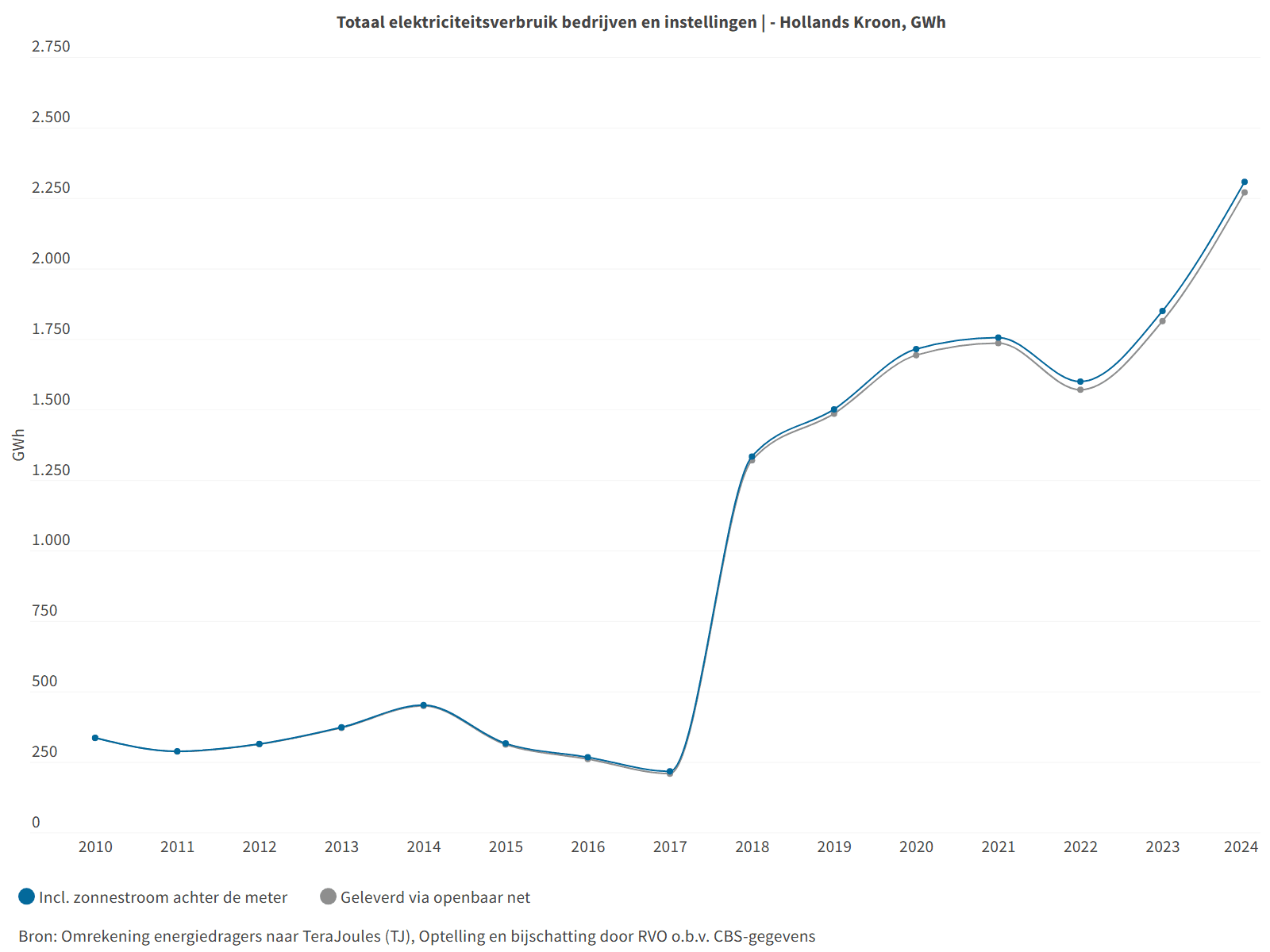
For context: according to official figures, business electricity consumption in Hollands Kroon (where Microsoft has a significant hyperscale footprint) rose from around 0,25 TWh in 2017 to around 2,25 TWh in 2024.
Open Questions
Our research raises several questions that we believe deserve answers:
For Microsoft: What is the actual grid capacity and electricity consumption of your owned, operated and leased data centers in the Netherlands right now? And what is your estimate for the coming years?
For RVO and Ministry of Economic Affairs of the Netherlands: Why are data centers for Microsoft in Hollands Kroon missing from the EED data that was published on the RVO website? Have you undertaken any compliance/enforcement action vis-a-vis Microsoft?
For Dutch policymakers at the municipal, provincial and national level: How can we have evidence-based decision-making vis-a-vis data centers and their energy footprint, if essential data is not public? And how much scarce grid capacity and scarce electricity may this sector and individual corporations in this sector use?
Conclusions
This research does not aim to point fingers. It aims to raise questions we believe matter for a proper public debate on data centers. As we have written above, we welcome corrections, critiques, and additional data that would improve our estimates.